學術論文Academic Publication
URSI GASS 2026 學術論文URSI GASS 2026 Publication
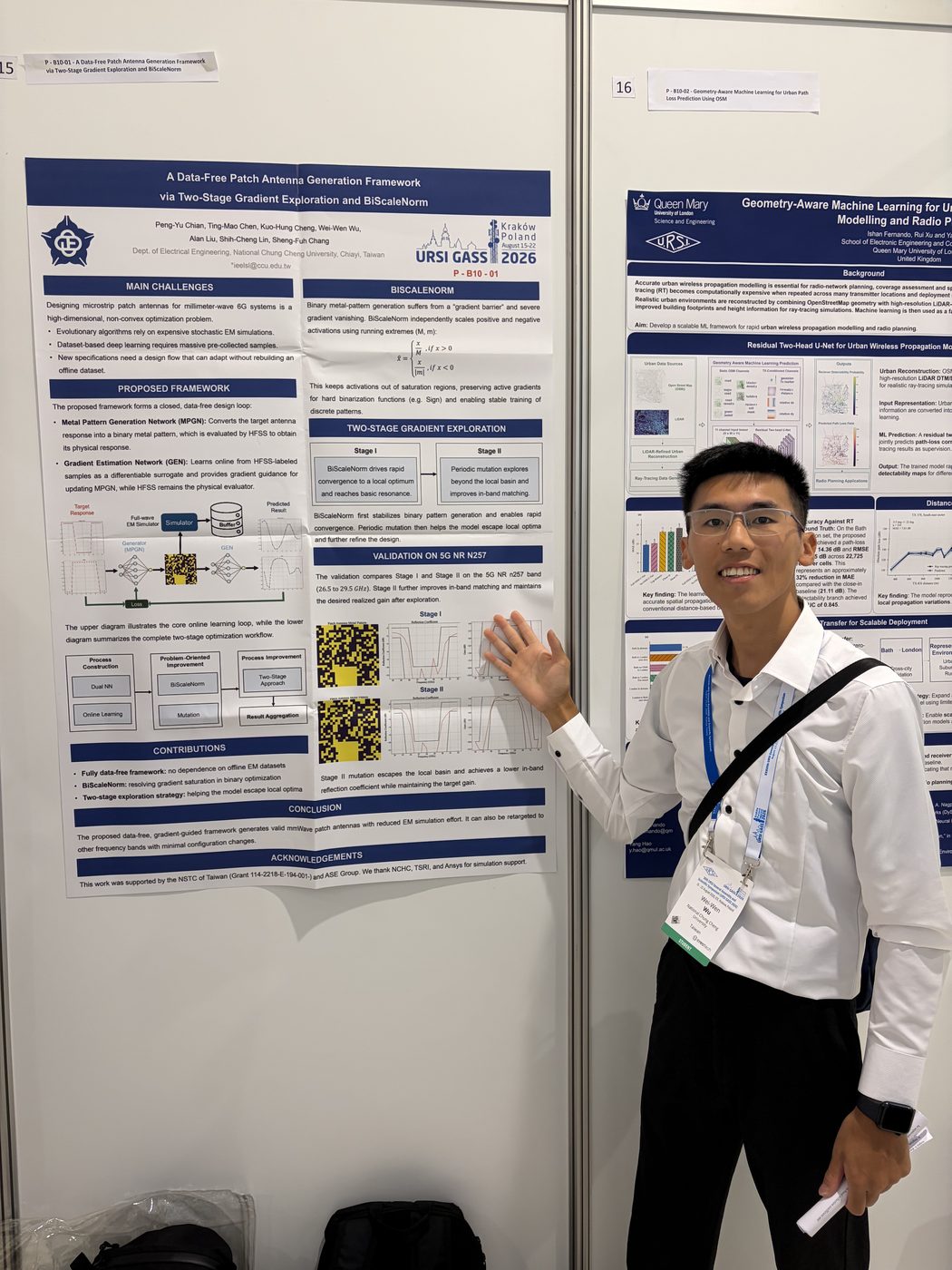
A Data-Free Patch Antenna Generation Framework via Two-Stage Gradient Exploration and BiScaleNorm. 發表於 2026 年 URSI GASS 波蘭克拉科夫會議。A data-free patch antenna generation framework presented at URSI GASS 2026, Kraków, Poland.
研究概述Overview
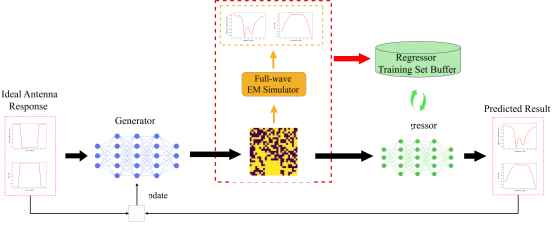
設計 6G 毫米波微帶貼片天線面臨高維度、非凸優化的挑戰。傳統演算法過於耗時,而深度學習則依賴龐大的預先採集數據集。本研究提出一種全新的「無資料 (Data-Free)」金屬圖形生成網路 (MPGN) 框架,無需預先收集資料集,即可針對特定規格生成高效的天線拓樸。Designing mmWave 6G antennas is challenging due to high-dimensional optimization landscapes. Traditional methods are slow, and deep learning relies on massive datasets. This study proposes a novel, data-free Metal Pattern Generation Network (MPGN) framework that generates efficient antenna topologies without pre-collected data.
關鍵技術與方法Key Methodology
- BiScaleNorm: 針對二值化金屬圖形生成的非線性正規化技術。以運行極值(running extremes M、m)分別縮放正負激活值,避免激活值漂移至飽和區,藉此解決梯度消失問題,確保硬二值化函數(Sign)能穩定訓練。 A non-linear normalization for binary pattern generation. It scales positive and negative activations independently using running extremes (M, m), keeping them out of saturation to solve gradient vanishing and enable stable training with hard Sign functions.
- Gradient Estimation Network (GEN): 作為與生成器同步訓練的線上可微分替代模型,即時預測天線性能並提供梯度導引;相較於進化演算法的大量隨機迭代,可將所需的 HFSS 模擬次數降低數個數量級(至少達數百倍)。 An online differentiable surrogate trained alongside the generator that predicts performance and provides gradient guidance; versus the massive stochastic iterations of evolutionary algorithms, it reduces required HFSS simulations by orders of magnitude (at least hundreds-fold).
- Two-Stage Gradient Exploration: 第一階段利用 BiScaleNorm 快速收斂,第二階段引入週期性變異機制跳出局部最優,確保性能持續提升。 A strategy where Stage I uses BiScaleNorm for rapid convergence, while Stage II introduces periodic mutations to escape local optima.
驗證結果Results
在 5G n257 頻段 (26.5-29.5 GHz) 驗證中,本框架成功生成高效雙層貼片天線。結果顯示,反射係數 (S11) 顯著降低至 -10 dB 以下,且維持超過 4 dB 的平坦實現增益。對比實驗證明,BiScaleNorm 的穩定性遠優於 LayerNorm 等標準基準。Validated on the 5G n257 band (26.5-29.5 GHz), the framework successfully generated high-efficiency antennas. S11 was reduced below -10 dB, with flat realized gain exceeding 4 dB. BiScaleNorm demonstrated superior stability over standard baselines like LayerNorm.
- 反射係數 S11 於目標頻段壓至 −10 dB 以下,達成良好阻抗匹配。Reflection coefficient S11 driven below −10 dB across the target band — good impedance matching.
- 通帶內維持超過 4 dB 的平坦實現增益。Flat realized gain exceeding 4 dB across the passband.
- 消融實驗中,BiScaleNorm 的訓練穩定性明顯優於 LayerNorm 等標準正規化基準(後者因梯度消失而無法達成有效共振)。In ablations, BiScaleNorm shows markedly better training stability than standard baselines such as LayerNorm, which failed to reach valid resonance due to gradient vanishing.
- 泛化性:僅需少量設定調整,同一框架即可套用到其他頻段,展現作為通用 mmWave 元件設計方案的潛力。Generalizability: with minimal configuration changes, the same framework adapts to other frequency bands — showing potential as a generic solution for mmWave components.
發表資訊Publication
- 作者Authors
- Peng-Yu Chian、Ting-Mao Chen、Kuo-Hung Cheng*、吳維文(Wei-Wen Wu)、Alan Liu、Shih-Cheng Lin、Sheng-Fuh Chang(國立中正大學;*通訊作者)Peng-Yu Chian, Ting-Mao Chen, Kuo-Hung Cheng*, Wei-Wen Wu, Alan Liu, Shih-Cheng Lin, Sheng-Fuh Chang (National Chung Cheng University; *corresponding author)
- 會議Venue
- URSI General Assembly and Scientific Symposium (URSI GASS 2026)
- 形式Format
- 海報發表(已接受)Poster (accepted)
- 地點Location
- 波蘭・克拉科夫Kraków, Poland
- 時間Date
- 2026 / 08 (15–22)
← 看碩士研究全貌← Full M.S. research 參加證明 PDF ↗Attendance certificate PDF ↗ URSI GASS 2026 官網 ↗URSI GASS 2026 site ↗
研討會現場At the Conference