碩士研究M.S. Research
AI 輔助貼片天線設計AI-Assisted Patch Antenna Design
以無需資料集、無需 GPU 的線上深度學習,自動生成可製造的 28 GHz 貼片天線金屬圖樣。Data-free, GPU-free online deep learning that generates manufacturable 28 GHz patch-antenna metal patterns.
碩士論文題目M.S. Thesis Title
自適應循環策略與圖譜連通度損失函數於貼片天線金屬圖形生成之研究A Study of Metal Pattern Design Generation for Patch Antennas Based on an Adaptive Cyclical Policy and Spectral Connectivity Loss Function
國立中正大學 電機工程研究所 · 指導教授:劉立頌 博士 · 2026 年 6 月Dept. of Electrical Engineering, National Chung Cheng University · Advisor: Prof. Alan Liu · June 2026
概述Overview
電磁模擬器不可微分,且自由拓樸的金屬圖樣搜索空間極大(25×25 二值像素 = 2⁶²⁵)。本研究以梯度估計網路(GEN)將模擬轉為可優化,並提出三項機制解決局部解、金屬孤島與樣本效率問題。EM simulators are non-differentiable and the free-topology search space is enormous (a 25×25 binary grid = 2⁶²⁵). A Gradient Estimation Network makes simulation optimizable, and three mechanisms address local optima, metal islands, and sample efficiency.
研究動機Motivation
5G/6G 毫米波系統需要高效率、易製造的貼片天線;傳統設計仰賴工程師經驗與大量電磁模擬試誤,耗時且難以跳脫既有拓樸。若能讓 AI 直接「生成」金屬圖樣,便能探索人類不會想到的自由拓樸,並在規格改變時快速重新設計。難點在於:電磁模擬器不可微分、設計空間是天文數字級的離散組合、生成結果還必須「可被製造」(金屬不能斷裂成孤島)。本研究針對這三點,提出端到端、無需資料集的生成式解法。5G/6G mmWave systems need efficient, manufacturable patch antennas; conventional design leans on engineer intuition and exhaustive EM trial-and-error — slow and hard to escape known topologies. Letting AI directly generate the metal pattern opens free-form topologies a human would not try, and enables rapid re-design when specs change. The difficulties: EM simulators are non-differentiable, the design space is an astronomically large discrete combination, and the result must be manufacturable (no disconnected metal islands). This work addresses all three with an end-to-end, data-free generative method.
問題Problem
電磁模擬器不可微分,且自由拓樸的金屬圖樣搜索空間極大(25×25 二值像素 = 2625 種組合)。以梯度估計網路(GEN)將模擬轉為可優化雖可行,但純梯度法有三大缺陷:收斂停滯於局部解、產生破壞電流路徑的金屬孤島、以及冷啟動下樣本效率低落。後處理修補孤島屬被動策略,易破壞有效金屬集群。 EM simulators are non-differentiable, and the free-topology search space is enormous (a 25×25 binary grid = 2625 combinations). A Gradient Estimation Network (GEN) makes simulation optimizable, but a purely gradient-driven approach has three defects: convergence stalls in local optima, disconnected metal islands that break the resonant current path, and poor sample efficiency under cold-start. Post-hoc island repair is passive and can destroy electromagnetically useful metal.
方法Method
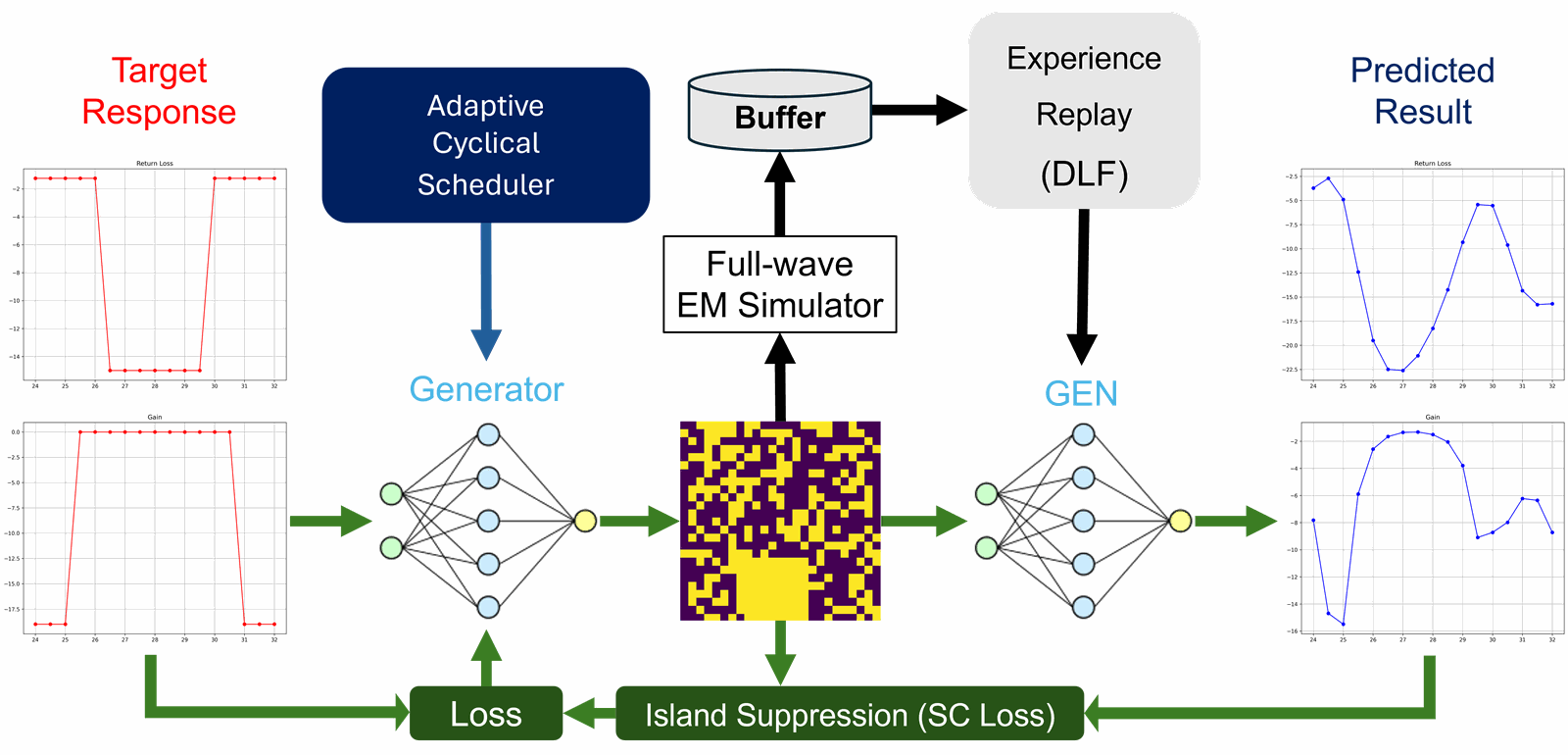
- 生成器 + 可微代理模型(GEN):皆為 MLP;代理模型每輪由回放緩衝區線上即時更新,無需預蒐集資料集。Generator + differentiable surrogate (GEN): both MLPs; the surrogate is updated online each iteration from a replay buffer — no pre-collected dataset.
- ACP 自適應循環策略:以主動式高原偵測 + 自適應重啟取代固定週期排程,並將學習率與二值化溫度 τ 綁在同一退火曲線,於單一階段內兼顧探索與邊界銳化。ACP (Adaptive Cyclical Policy): plateau detection + adaptive restart replaces fixed-period scheduling; couples learning rate with a binarization temperature τ on one annealing curve, balancing exploration and boundary-sharpening in a single stage.
- KNS Loss 鄰域平滑損失(自行設計的中間步驟):以 k×k 卷積把 TV Loss 的一維緊鄰擴大為二維面偵測孤島;但局部算子仍看不到「微觀相連、宏觀卻整塊斷裂」的情形,因而催生下述全域圖譜方法。KNS Loss (a self-designed interim step): a k-neighborhood smoothing loss that widens TV Loss's 1-D adjacency to a k×k patch; yet local operators still miss "micro-connected but macro-broken" topologies, motivating the global spectral loss below.
- SC Loss 圖譜連通損失:以圖拉普拉斯的代數連通度(Fiedler 值 λ₂)倒數作為端到端可微的拓樸懲罰,於訓練期主動消除孤島,免去後處理。SC Loss (Spectral Connectivity Loss): uses the reciprocal of the graph Laplacian's algebraic connectivity (Fiedler value λ₂) as a differentiable topology penalty, eliminating islands during training instead of post-processing.
- DLF 動態損失過濾:經驗回放機制,以歷史最佳損失為自適應門檻,門檻隨模型提升收緊,在不增加模擬次數下提升樣本資訊密度。DLF (Dynamic Loss Filter): experience replay whose elite threshold tracks the running-best loss, raising sample information density without extra EM simulations.
- 可微二值化 + 物理熱啟動:溫度控制 sigmoid 搭配直通估計(STE);以傳輸線理論推算 28 GHz 初始幾何取代隨機初始化。Differentiable binarization + physics warm-start: temperature-controlled sigmoid with a straight-through estimator; a transmission-line-theory initial geometry replaces random init.
設定Setup
- 頻段Band
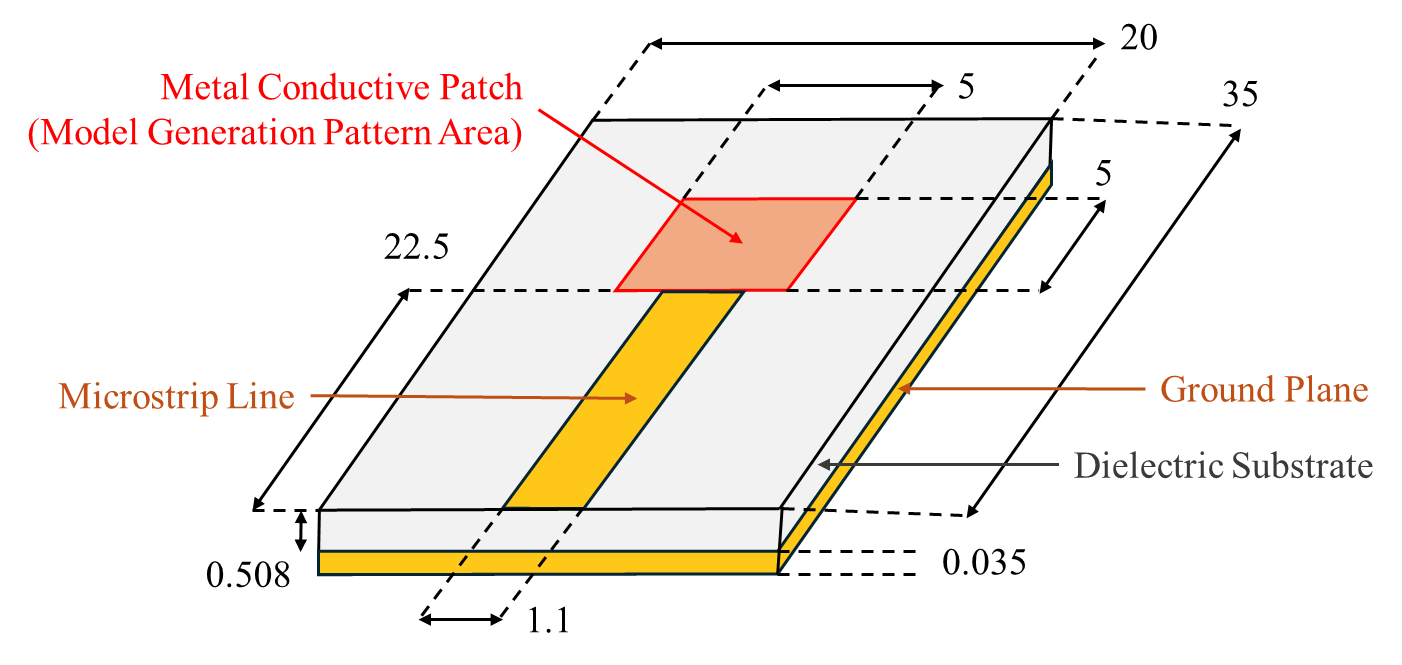
- 28 GHz(5G NR n257,26.5–29.5 GHz 毫米波)28 GHz (5G NR n257, 26.5–29.5 GHz mmWave)
- 基板Substrate
- Rogers RO4003C(εr 3.55, h 0.508 mm)
- 設計區Design region
- 5×5 mm · 25×25 像素(0.2 mm/px)5×5 mm · 25×25 pixels (0.2 mm/px)
- 目標規格Target spec
- 頻段內 S11 < −10 dB、增益 > 4 dBIn-band S11 < −10 dB, gain > 4 dB
- 模擬器Simulator
- Ansys HFSS 2023 R2
- 運算Compute
- 純 CPU(i9-14900 · 24C/32T · 128 GB · 無 GPU)· Python 3.11 · PyTorch 2.5CPU-only (i9-14900 · 24C/32T · 128 GB · no GPU) · Python 3.11 · PyTorch 2.5
- 收斂Convergence
- 單埠約 1000 迭代(每次迭代含一次 HFSS 全波模擬)~1000 iterations for the single-port design (each iteration runs one HFSS full-wave simulation)
結果(HFSS 全波驗證)Results (HFSS-validated)
- ACP&SC&DLF 全系統:響應損失壓至 0.99 dB,同時饋入連通性 Rfeed = 61.98%,電磁性能與可製造性雙優。Full ACP&SC&DLF: response loss down to 0.99 dB with feed reachability Rfeed = 61.98% — best on both performance and manufacturability.
- 連通性:SC Loss 將饋入連通性由約 18.89% 提升至 60%+(高權重可達 98%)。Connectivity: SC Loss raises feed reachability from ~18.89% to 60%+ (up to 98% at high weight).
- 收斂:DLF 使最小損失較基準改善逾 50%。Convergence: DLF cuts the minimum loss by over 50% vs. baseline.
- 泛用性:同一框架不調超參即生成合規的雙埠濾波器,驗證規格無關性。Generality: the same framework, untuned, also generates a spec-compliant dual-port filter.
| 機制組合Configuration | 響應損失Response Loss (dB) | Rfeed (%) |
|---|---|---|
| Base | 3.64 | 27.22 |
| DLF | 1.71 | 16.28 |
| ACP | 2.07 | 18.89 |
| ACP & DLF | 0.0 | 14.01 |
| ACP & SC & DLF | 0.99 | 61.98 |
主要貢獻Key Contributions
- 將不可微分的電磁設計,轉化為可端到端梯度優化的問題(GEN 線上代理模型)。Recasts non-differentiable EM design as an end-to-end gradient-optimizable problem (the GEN online surrogate).
- 提出 ACP 自適應循環策略,於單一階段內自動平衡探索與收斂,免去人工排程的超參調校。Introduces the Adaptive Cyclical Policy (ACP) that auto-balances exploration and convergence in a single stage, removing hand-tuned schedules.
- 以圖譜連通度(Fiedler 值 λ₂)設計可微的連通性損失(SC Loss),於訓練期內生地保證可製造性,免去後處理修補。Designs a differentiable connectivity loss (SC Loss) from algebraic connectivity (Fiedler value λ₂), guaranteeing manufacturability during training rather than by post-hoc repair.
- 全程純 CPU、無需預先蒐集資料集,降低研究門檻;同一框架不調參即可生成雙埠濾波器,具規格無關之泛用性。CPU-only and data-free, lowering the barrier to entry; the same untuned framework also generates a dual-port filter, showing spec-agnostic generality.
相關發表Related Publication
本研究之延伸成果〈A Data-Free Patch Antenna Generation Framework via Two-Stage Gradient Exploration and BiScaleNorm〉已獲 URSI GASS 2026(波蘭克拉科夫)接收,以海報形式發表。An extension of this work — "A Data-Free Patch Antenna Generation Framework via Two-Stage Gradient Exploration and BiScaleNorm" — has been accepted as a poster at URSI GASS 2026 (Kraków, Poland).