國科會大專生研究計畫 · 2022–2023NSTC Undergraduate Research Grant · 2022–2023
深度影像機械手臂人機互動介面Depth-Vision Robotic-Arm HMI
結合六軸機械手臂與深度影像辨識,使用者只要在螢幕點選物體,手臂便能將其移至指定位置 — 整合 GGCNN 抓取規劃、YOLO 手勢辨識與 ROS2/Webots 模擬。A six-axis arm with depth-vision recognition: tap an object on screen and the arm moves it to a target — integrating GGCNN grasp planning, YOLO gesture recognition, and ROS2/Webots simulation.
概述Overview
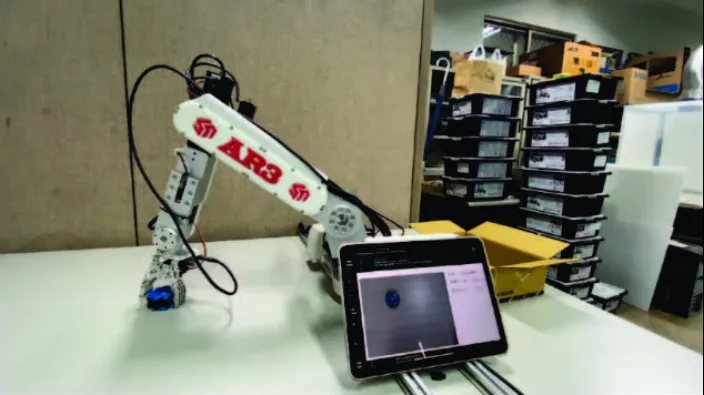
本計畫開發一套結合六軸機械手臂與深度影像辨識(搭配深度學習)的人機互動介面。設計理念是讓「取什麼、放到哪」由人決定 — 使用者只要在螢幕上點一下物體,手臂便會自動將它移到指定位置。計畫期間完成了手臂通訊、正逆向運動學、像素轉實際長度的座標校正與物體辨識,並成功以純深度影像(不依賴顏色資訊)辨識並抓取物體,後續再朝物體堆疊、非平面與圓錐形等複雜情境擴展。This grant project built a human–machine interface combining a six-axis arm with depth-vision recognition (plus deep learning). The idea is to let a human decide what to pick and where to place it — tap an object on screen and the arm moves it there automatically. The project implemented arm communication, forward/inverse kinematics, pixel-to-real-length calibration, and object recognition, and successfully grasped objects from depth images alone (no color cues), with later extensions toward stacked, non-planar, and conical objects.
研究動機Motivation
工業機器人的安裝量持續攀升(2021 年全球新安裝量達 517,385 台,創歷史新高),智慧工廠對「結合影像感測器、能即時操控」的自動化需求也隨之提高。傳統視覺抓取容易受光線干擾,因此本計畫改以深度影像搭配深度學習,在弱化顏色與光照依賴的前提下完成辨識與抓取,並以直覺的人機介面降低操作門檻。Industrial-robot installations keep climbing (a record 517,385 units installed worldwide in 2021), raising demand for vision-sensor-driven automation with real-time control. Conventional vision grasping is sensitive to lighting, so this project pairs depth imaging with deep learning to recognize and grasp with reduced color/illumination dependence, behind an intuitive interface that lowers the operating barrier.
系統方法Method
- 深度影像感測Depth sensing
以 Intel RealSense D435 取得對齊的深度影像,作為辨識與抓取的主要輸入。Intel RealSense D435 provides aligned depth images as the primary input for recognition and grasping. - 座標校正Coordinate calibration
依相機內參與深度動態計算水平/垂直視野(HFOV/VFOV),將像素座標轉換為實際空間長度,並以 OpenCV 進行輪廓分析。Using intrinsics and depth, HFOV/VFOV are computed dynamically to map pixels to real-world lengths, with OpenCV contour analysis. - 運動學求解Kinematics
以 DH 模型定義手臂參數,完成正向/逆向運動學與多軸角度控制,將目標座標轉為各關節角度。A DH model defines the arm; forward/inverse kinematics and multi-axis angle control turn target coordinates into joint angles. - 抓取規劃(GGCNN)Grasp planning (GGCNN)
以 GGCNN 演算法處理抓取場景,估計物體角度並辨識物體堆疊狀況,產生可行的抓取姿態。GGCNN handles the grasping scene — estimating object angle and detecting stacking — to produce feasible grasp poses. - 手勢辨識(YOLO)Gesture recognition (YOLO)
以 YOLO(TensorFlow/Keras)辨識手勢,作為操作指令的另一種輸入方式。YOLO (TensorFlow/Keras) recognizes hand gestures as an alternative command input. - ROS2 整合與模擬ROS2 integration & simulation
於 ROS2 架構下整合各模組,以 MoveIt 進行路徑規劃,並在 Webots 中模擬驗證後再與實機互通。Modules are integrated under ROS2, with MoveIt for path planning, validated in Webots simulation before bridging to the real arm.
主要成果Key Results
- 完成手臂通訊、正逆向運動學、像素轉實際長度校正與物體辨識的完整流程。Completed the full pipeline of arm communication, forward/inverse kinematics, pixel-to-length calibration, and object recognition.
- 成功以純深度影像辨識並抓取物體,降低對顏色與光照的依賴。Grasped objects from depth images alone, reducing color/illumination dependence.
- 人機介面支援點選取放:指定 A、B 兩點取放,並可在搬運途中改變目的地。The HMI supports click-to-place: designate A/B pick-and-place points and re-target the destination mid-transfer.
- 於 Webots 完成模擬驗證,並達成 ROS2 與模擬軟體互通,朝非平面、堆疊等複雜場景擴展。Validated in Webots with ROS2–simulation interoperability, extending toward non-planar and stacked scenes.
技術棧Tech Stack
- 手臂Arm
- AR3 六軸機械手臂AR3 six-axis arm
- 相機Camera
- Intel RealSense D435 (Depth)
- 深度學習Deep learning
- GGCNN(抓取)、YOLO 手勢(TensorFlow/Keras)GGCNN (grasping), YOLO gesture (TensorFlow/Keras)
- 影像處理Vision
- OpenCV 輪廓分析、HFOV/VFOV 視野計算OpenCV contours, HFOV/VFOV mapping
- 機器人Robotics
- ROS2、MoveIt 路徑規劃、Webots 模擬ROS2, MoveIt planning, Webots simulation
- 運動學Kinematics
- DH 模型、正/逆向運動學DH model, forward/inverse kinematics
工程證據Engineering Evidence
技術Tech
本計畫與我的畢業專題(YOLOv7+OpenCV 視覺抓取)互為延伸:專題著重「類別+角度」的二維抓取,本計畫則進一步以純深度影像、GGCNN 與 ROS2 模擬處理立體與堆疊場景。This grant extends my capstone (YOLOv7 + OpenCV grasping): the capstone focuses on 2-D "class + angle" grasping, while this project adds depth-only sensing, GGCNN, and ROS2 simulation for 3-D and stacked scenes.